We humans like to see ourselves as unique among the world. We are the only animals to invent things as distinct as opera and pneumatic hammers. We come up with things like candy, religion, and the Internet, and it makes us feel very special and different.
But if you ask a neurologist, you'll see leftovers from previous brain developments. We like to think of ourselves as a solidly different mind, but the civilized human is just the top layer. It's bolted onto a social-climbing, tribal, fang-baring, poop-flinging, chimp. And the chimp is bolted in turn on a territorial, furious, horny lizard. And the lower levels often show through routinely.
If you've ever shaken a fist in fury because someone cut you off in traffic, that's the lizard. It sees the space as yours and resents this other jackass's intrusion. It's wired to pick a fight with your competitor to force him or her to leave your space. The reasons vary by your gender (a female lizard wants a safe place to raise her eggs, a male lizard wants to show how well he can defend his mate's nest), but it will do little good in a car. After all, you're both in a big steel cage, moving at high speed. Attempting to fight will at best only injure yourself pointlessly. (That and both of you will have literally vacated the spot in 30 seconds if you just wait anyway.)
If you've ever had the urge to have a big party on Wednesday night despite having work on Thursday, you have the lizard to thank for that piece of impulsiveness too. Lizards don't really benefit from planning ahead, so they want to get all their impulses done NOW. And they aren't complex impulses. Stuff your face with food, find a mate and make some more lizards, and maybe modify your mind a bit with some fermented fruit, or that interesting cactus. That we humans have many more ways to modify our mind, usually to our detriment, doesn't help matters.
If you've ever wanted to throw up because you have to give a speech (be it for school, or a business presentation), hey, it's the lizard yet again. It's saying "Hey, don't do this status grab, fool, you might get killed." That the social consequences will be worse for not doing it doesn't occur to the lizard. After all, lizard social options are kind of limited. (Mostly to "bite that asswipe," "Ignore him," "Hey, check out my bod," and "mine, MINE MINE, back off or I'll kick your ass")
If you've ever blown your paycheck, it's the lizard yet again. Lizard doesn't grasp why you shouldn't just leap into the trough and eat until you can't move, or whatever it is that you want to do and it only kind of understands. The idea of "saving" doesn't really make sense to it. And "planning for the future?" Ridiculous, if you don't go get yourself a huge stash of bugs in your belly you clearly won't survive the inevitable famine. What do you mean food costs "money?" Clearly you should trade this "money" for more food, else what good is it, right human? What do you mean this "i-pod" thing cannot be eaten? If you can't eat it, why else would you want it so badly?
If you ever leered at a person until they got pissed off, ruining any chase you had with them, guess who's back? The lizard wants to make more lizards. Lots more lizards. Too much is not enough. This gives men the urge to check out the rack of every woman he can see, just to make sure if she'd make good kids with him. Women might be more discrete about this, but I've heard many a rant on a guy having a "spankable ass" and "awesome muscles." Somebody's leering.
If you've ever put off something until it was much too late and then had to stay up a week to do it, hello again! This doesn't feel good, why are we doing it again? See, to the lizard, everything that feels good directly influences their survival. Shoving everything edible into your face? Awesome, you survive the famine. Making more lizards? Awesome, once the eggs are laid they take care of themselves. Getting totally blitzed? Well, you didn't have anything to do until this evening anyway, and this will make the daily sunning much more fun. Consequences? Consequences are for mammals, who have to RAISE their offspring, whose veins will clog if they get too obese, and so on. And that term paper? Lizard cannot even grasp such a concept.
Now, these might sound like the lizard part is a bad thing that should be eliminated as soon as possible, but we didn't keep it for no reason. If you have a gibbering fear of death, that's the lizard. Being dead sucks, but if you weren't afraid of it, you'd step in front of a bus the moment things got hard because corpses have no problems. Same for the urge to reproduce. It's a lot harder for us humans, who don't just lay eggs and leave like they do. Without a little baby-craze, humans would be a rather uncommon and embattled species.
Now the monkey is a tad more complex. It understands the idea of having relationships with others of your own kind besides picking fights and mating. It grasps that cooperation is the best way to survive, so it encourages you to form a tribe. The tribe will help each other find food, develop a guard shift so that everyone can sleep but there is never a time when everyone is asleep, and smooth over some of the fighting. It gives you the more complicated emotions, like happiness, shame, and affection. So far, so good.
Unfortunately, the monkey often has strange ideas about the purity of the tribe. Any outsiders show up? Scream and hurl poop until they run away. In us humans, the poop-flining is now metaphorical, thankfully with invective and rude hand gestures. (Man, wouldn't it be horrifying if you angered somebody and their first response was to take off their pants and poop into their hands?) Anyone contradict you? Scream and hurl some more poop, that'll teach them. Someone too different from you? Kill, kill, before he affects the others! Rrarrrgh!
You see, the monkey started with the correct idea of mutual defense, but it's incredibly stupid and impulsive. In nature one must make snap decisions, but in any decent society, these decisions are the very avatar of wrong. Monkeys have no police, we do.
The monkey is also responsible for moronic dare taking. From an objective viewpoint, almost all peer pressure revolves around unbelievably stupid crap. If a complete stranger dared you to, let's say, cram a broken bottle containing a firework into your anus and then light it, you'd rightly tell him to go fuck off. But if your best friend dares you, hurrr, okay! This is because the monkey is all about status, and will do any moronic thing to keep it. Oh man, if I don't drive this car off a cliff into the jagged rocks below, my friends won't respect me anymore. I can't be a wuss in their eyes, I'll do it!
Now, all of this is not to condemn humankind to eternal stupidity. Since the lizard and the monkey are seperate, you can play them off each other for best results. If someone pulls a gun on you, the monkey will scream "fight! Fight!" whereas the lizard will tell you "run, moron!" Go with the lizard. If you have a term paper due next month, the lizard will be like "Meh, this isn't fun," but the monkey will insist "Do it, it's important!" Go with the monkey.
Thursday, May 7, 2009

Wednesday, May 6, 2009
Lessons of Simulation Systems
So far I have four parts of this project detailing the requirements for jobs. I've noticed some patterns about what traits are more valuable than others. I will re-describe the traits here rather than redirect you to the first post. The traits come from three sources. One is Dungeons and Dragons, as a way of simulating a person very different from the player who controls him or her. (D&D games would be kind of dull if you had to play as yourself.)
The second is the Meyers-Briggs personality test, that notes four dichotomies in human behavior and classifies people by their preferred positions on this. In an MB test, all people have all eight traits, but express four of them more and in preference to the other four.
D&D Traits, by value:
* Charisma
The term Charisma comes from the ancient Greek idea that people with a lot of this traits were specifically blessed by the gods, and the term is Greek for "divine gift." People with lots of Charisma are charming, influential, witty, and make friends easily. Although it is a function purely of personality and mind, visual media often make use of a standard of depicting high-charisma people are more attractive to demonstrate its influence. (Strange-looking people may actually be charismatic in real life. Case in point, Adolf Hitler moved enormous crowds despite being not only bizarre looking, but a complete weirdo to boot. Plus questionably sane.)
Charisma is valued because of the way that it allows one to influence people. A primary need of companies is to influence people into giving money to the company. (By, say, buying something.) Failing that, Charisma is also useful for convincing other people that your ideas are right and should be followed. Even technicians must convince their boss that they are in fact working as best they know how and that the project they are working on is indeed a good idea.
Failing THAT too, few projects are the result of one person. Employees are expected to be "Team Players," and operate with other people without fighting or arguing. Even if the other person is wrong, obnoxious, stupid, or insufferable. Don't be insufferable, or firing you will seem like an excellent idea.
* Wisdom
Wisdom is poorly defined in D&D, but it seems to consist mostly of being observant, detail-oriented, and prudent. Having poor wisdom makes a person oblivious and impulsive. Both obliviousness and impulsiveness are bad traits in the working world, as they create additional work for at least your boss, and quite possibly more work for yourself too. Companies prefer self-directed employees that do necessary tasks without being repeatedly reminded.
Most tasks also benefit from observing the details as they fill out, to note for small problems before they become big ones. Also, like Charisma, Wisdom is purely mental. One cannot assess this trait merely at a glance.
* Intelligence
Intelligence measures a person's ability to reason and learn. Very important for white collar positions, or where training is important. Beyond a certain level, it ceases to provide benefits to something like 75% of all positions. Again, this doesn't mean that one can ignore this trait, as an ignoramus is not an attractive candidate for anything.
Most people would imagine that this trait would be very important, but that is not the case.
* Constitution
Constitution is a measure of a person's general healthiness. Medical insurance is getting expensive, and all else being equal, a person with a better constitution is preferable because they will make fewer claims and cost less. Also, they can safely work more hours, which doesn't go unnoticed.
* Dexterity
Dexterity is about being able to move both quickly and accurately. One measurement in D&D, but at least five or six different ones for real life. Most people would be fine with a moderate score in this. (But not too low. Clumsiness equals injury, equals insurance claim, equals lost money for them.) Some jobs do require higher levels, mostly those requiring precision work. Moderate dexterity should be sufficient for 75% of available jobs.
* Strength
Strength, the having of muscles and ability to use them forcefully, is actually the least useful trait for modern work. The need for muscle is mostly replaced by machines. Some athletes need it, and anyone who must physically overpower someone needs it, and anyone who needs to haul things needs it. But most modern work could be done by somebody weak as a kitten.
And now for MB traits. Again, from most valuable to least valuable for getting a job. Both Meyers and Briggs would tell me that I'm doing it wrong, that all people actually have all eight traits but that the test measures preference, and that all types are equal, but I have noticed a trend to prefer certain traits over others. Still, as a nod to Mr. Meyers and Ms. Briggs, I will note what would happen if a company was devoid of one particular trait.
* Extroversion
An extroverted person loves to talk to people and meet them and discuss things. They feel sad and unimportant if they have no one to talk to. The highest paying position require this trait. It is countered by Introversion. A company that lacked this trait entirely would be a dysfunctional group that navel-stared excessively. Marketing could not function, leading to a quick financial death.
* Sensing
Sensing people prefer to look at the little details instead of the big picture. This helps them maintain accuracy, and avoid error. Sensing people are called that because they tend to prefer to have direct tangible evidence for a proposition, instead of the indirect logic preferred by their counterpart, the Intuitive. A company that lacked this trait would be bogged down by series of small errors that quickly grew into massive problems because nobody noticed.
* Feeling
Feeling people are somewhat empathic, concerned with the feelings of other people and themselves. They tend towards artistic natures, and work hard to maintain group morale. The opposing trait is Thinking. A company lacking this trait would degenerate into perpetual office politics and trolling, and nothing useful could get done. Also, everyone would drive each other completely insane.
* Thinking
Thinking people prefer a detached style, logically considering every situation from the outside. Their style is quite useful for detecting maladaptive patterns. The opposing trait is Feeling. A company lacking this trait would waste all its time on touchy-feely exercises and never contribute useful work. (Although the workers would be remarkably sane.)
* Intuitive
The Intuitive like abstractions, the large picture, and eschew details. This helps them stay on track, as the little details would drive them mad from micromanagement. They are best convinced with an abstract and logical argument for a proposition, revolving around principles. The opposite trait is Sensing. A company lacking this trait would be unable to see a project through, as it obsessed on the small details to the detriment of the rest of the project.
* Judging
Judging types want to come to a snap decision, now. If it is the right decision, awesome. If it is the wrong decision, uh oh. A company of pure judgers would be massively impulsive, probably pathologically so. It is opposed by perceiving.
* Perceiving
Perceiving types want to delay decision making until all the information is available to them. This decision will therefore certainly be right. A company of pure perceivers would die of analysis paralysis. It is opposed by judging.
* Introversion
Introverted people want to reflect and do things by themselves. It may come last on this list, but a company starts to need introverts when it has more than 5 or so people. Pure extroverts would die of boredom doing the kind of things that introverts do. Accounting and research especially. A company lacking introverts would be easily out-competed.
For my readers: If you dislike your trait-measurements, how would you adjust them?
The second is the Meyers-Briggs personality test, that notes four dichotomies in human behavior and classifies people by their preferred positions on this. In an MB test, all people have all eight traits, but express four of them more and in preference to the other four.
D&D Traits, by value:
* Charisma
The term Charisma comes from the ancient Greek idea that people with a lot of this traits were specifically blessed by the gods, and the term is Greek for "divine gift." People with lots of Charisma are charming, influential, witty, and make friends easily. Although it is a function purely of personality and mind, visual media often make use of a standard of depicting high-charisma people are more attractive to demonstrate its influence. (Strange-looking people may actually be charismatic in real life. Case in point, Adolf Hitler moved enormous crowds despite being not only bizarre looking, but a complete weirdo to boot. Plus questionably sane.)
Charisma is valued because of the way that it allows one to influence people. A primary need of companies is to influence people into giving money to the company. (By, say, buying something.) Failing that, Charisma is also useful for convincing other people that your ideas are right and should be followed. Even technicians must convince their boss that they are in fact working as best they know how and that the project they are working on is indeed a good idea.
Failing THAT too, few projects are the result of one person. Employees are expected to be "Team Players," and operate with other people without fighting or arguing. Even if the other person is wrong, obnoxious, stupid, or insufferable. Don't be insufferable, or firing you will seem like an excellent idea.
* Wisdom
Wisdom is poorly defined in D&D, but it seems to consist mostly of being observant, detail-oriented, and prudent. Having poor wisdom makes a person oblivious and impulsive. Both obliviousness and impulsiveness are bad traits in the working world, as they create additional work for at least your boss, and quite possibly more work for yourself too. Companies prefer self-directed employees that do necessary tasks without being repeatedly reminded.
Most tasks also benefit from observing the details as they fill out, to note for small problems before they become big ones. Also, like Charisma, Wisdom is purely mental. One cannot assess this trait merely at a glance.
* Intelligence
Intelligence measures a person's ability to reason and learn. Very important for white collar positions, or where training is important. Beyond a certain level, it ceases to provide benefits to something like 75% of all positions. Again, this doesn't mean that one can ignore this trait, as an ignoramus is not an attractive candidate for anything.
Most people would imagine that this trait would be very important, but that is not the case.
* Constitution
Constitution is a measure of a person's general healthiness. Medical insurance is getting expensive, and all else being equal, a person with a better constitution is preferable because they will make fewer claims and cost less. Also, they can safely work more hours, which doesn't go unnoticed.
* Dexterity
Dexterity is about being able to move both quickly and accurately. One measurement in D&D, but at least five or six different ones for real life. Most people would be fine with a moderate score in this. (But not too low. Clumsiness equals injury, equals insurance claim, equals lost money for them.) Some jobs do require higher levels, mostly those requiring precision work. Moderate dexterity should be sufficient for 75% of available jobs.
* Strength
Strength, the having of muscles and ability to use them forcefully, is actually the least useful trait for modern work. The need for muscle is mostly replaced by machines. Some athletes need it, and anyone who must physically overpower someone needs it, and anyone who needs to haul things needs it. But most modern work could be done by somebody weak as a kitten.
And now for MB traits. Again, from most valuable to least valuable for getting a job. Both Meyers and Briggs would tell me that I'm doing it wrong, that all people actually have all eight traits but that the test measures preference, and that all types are equal, but I have noticed a trend to prefer certain traits over others. Still, as a nod to Mr. Meyers and Ms. Briggs, I will note what would happen if a company was devoid of one particular trait.
* Extroversion
An extroverted person loves to talk to people and meet them and discuss things. They feel sad and unimportant if they have no one to talk to. The highest paying position require this trait. It is countered by Introversion. A company that lacked this trait entirely would be a dysfunctional group that navel-stared excessively. Marketing could not function, leading to a quick financial death.
* Sensing
Sensing people prefer to look at the little details instead of the big picture. This helps them maintain accuracy, and avoid error. Sensing people are called that because they tend to prefer to have direct tangible evidence for a proposition, instead of the indirect logic preferred by their counterpart, the Intuitive. A company that lacked this trait would be bogged down by series of small errors that quickly grew into massive problems because nobody noticed.
* Feeling
Feeling people are somewhat empathic, concerned with the feelings of other people and themselves. They tend towards artistic natures, and work hard to maintain group morale. The opposing trait is Thinking. A company lacking this trait would degenerate into perpetual office politics and trolling, and nothing useful could get done. Also, everyone would drive each other completely insane.
* Thinking
Thinking people prefer a detached style, logically considering every situation from the outside. Their style is quite useful for detecting maladaptive patterns. The opposing trait is Feeling. A company lacking this trait would waste all its time on touchy-feely exercises and never contribute useful work. (Although the workers would be remarkably sane.)
* Intuitive
The Intuitive like abstractions, the large picture, and eschew details. This helps them stay on track, as the little details would drive them mad from micromanagement. They are best convinced with an abstract and logical argument for a proposition, revolving around principles. The opposite trait is Sensing. A company lacking this trait would be unable to see a project through, as it obsessed on the small details to the detriment of the rest of the project.
* Judging
Judging types want to come to a snap decision, now. If it is the right decision, awesome. If it is the wrong decision, uh oh. A company of pure judgers would be massively impulsive, probably pathologically so. It is opposed by perceiving.
* Perceiving
Perceiving types want to delay decision making until all the information is available to them. This decision will therefore certainly be right. A company of pure perceivers would die of analysis paralysis. It is opposed by judging.
* Introversion
Introverted people want to reflect and do things by themselves. It may come last on this list, but a company starts to need introverts when it has more than 5 or so people. Pure extroverts would die of boredom doing the kind of things that introverts do. Accounting and research especially. A company lacking introverts would be easily out-competed.
For my readers: If you dislike your trait-measurements, how would you adjust them?
Tuesday, May 5, 2009
Mad Engineering Illustrated, Badly
I think that some of the things I write up on this blog would be easier to understand if I drew them up. I'm not much of an artist, but I do have a CAD program that should display a reasonable approximation of layers, and later programs to add color for contrast. QCAD, ho!
First, the implantable glucose testing device. The device is planted in the arm, with the vein and the arm-bone shown.

Hm, that didn't help much Then, the artificial heart idea.
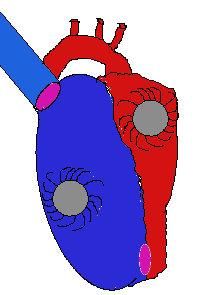
.....
QCAD, you're fired. Clearly not the tool for the CAD-inexperienced
user. GIMP, can you clean it up?

...Gah. You're fired too, GIMP. Hire artist.
First, the implantable glucose testing device. The device is planted in the arm, with the vein and the arm-bone shown.
Hm, that didn't help much Then, the artificial heart idea.
.....
QCAD, you're fired. Clearly not the tool for the CAD-inexperienced
user. GIMP, can you clean it up?
...Gah. You're fired too, GIMP. Hire artist.
Monday, May 4, 2009
Diabetic Monitoring Implant
One big problem for people with diabetes is having to monitor their blood sugar. If it gets too high, there are massive problems, but if it gets too low, that's even worse. Severe diabetics must always carry around with them a syringe full of insulin in case of the first, and a candy bar in case of the second. They need to avoid sugar consumption when not having a low-sugar attack, and would benefit from weight loss.
So I propose a monitoring implant. Vampirically powered, it would constantly record the glucose concentration of the blood flowing past it, harvesting a tiny amount of that to power itself. Using RFID technology, the records could be downloaded into a wristwatch-like device for display or transfer into a computer. Alternatively, it could signal the person in case of excessively high or low readings by some means that I have yet to determine. A friend of mine says to put it in the watch, which would be smart because the watch could have more complex and sophisticated circuitry.
The glucose use of the machine would treat the underlying problem of uncontrolled glucose use, and the stored information would eliminate the need for the constant finger-prick tests that a diabetic person has to undergo as it is. Since it would read continuously, the person would have a record of their blood sugar levels through the day for further management. If the person has a good memory, this could lead to the identification of patterns that would lead to better health.
As a secondary benefit, if the owner is overweight, this may lead to a slight weight loss.
So I propose a monitoring implant. Vampirically powered, it would constantly record the glucose concentration of the blood flowing past it, harvesting a tiny amount of that to power itself. Using RFID technology, the records could be downloaded into a wristwatch-like device for display or transfer into a computer. Alternatively, it could signal the person in case of excessively high or low readings by some means that I have yet to determine. A friend of mine says to put it in the watch, which would be smart because the watch could have more complex and sophisticated circuitry.
The glucose use of the machine would treat the underlying problem of uncontrolled glucose use, and the stored information would eliminate the need for the constant finger-prick tests that a diabetic person has to undergo as it is. Since it would read continuously, the person would have a record of their blood sugar levels through the day for further management. If the person has a good memory, this could lead to the identification of patterns that would lead to better health.
As a secondary benefit, if the owner is overweight, this may lead to a slight weight loss.
Sunday, May 3, 2009
Swine Flu
I've been asked many questions about Swine Flu, since the media and the populace is in uproar about it. I am not a doctor, this is not medical advice, and if you are told otherwise by a doctor, listen to the doctor and not to me. Please see a doctor if you have any medical concerns.
Influenza is a family of viruses. If you are infected with one, you typically feel feverish, nauseated (read: barfy), sore, headachy, coughy, and uncomfortable. They come in many strengths, most of which you can recover from in one day. There have been especially strong cases in the past, which have proven an epidemic health problem. It is not that bad yet. The most notorious case was the 1918 "Spanish" flu, which further compounded the suffering of a world deep in the first world war. Viruses are a form of life consisting of a protein jacket that must exploit more complicated life forms to reproduce. It reproduces by hijacking cells into a virus-factory until the cell dies. It then attempts to spread to other life-forms to ensure the presence of fresh cells.
Swine flu is not spread by touching pigs or eating pork. To explain why this newest batch of severe flu is called "Swine Flu," I have to talk about it's origins.
"Influenza" is Italian for "influence." Ancient Italian doctors believed that this was brought about by "influence of the cold." This was long before germ theory, so anyone telling them that the disease was actually caused by very small life would have been considered a crazy person. Since then, we have discovered that it is a virus, and that it has three subfamilies. One normally infects only humans, one infects only birds (especially chickens in filthy conditions), and one infects barnyard mammals, mostly pigs. Now, viruses and bacteria have developed, long ago, a system to exchange useful genetics with similar bacteria or viruses, in which they trade a genetic ring, the "plasmid" with each other to get useful genes to survive harsh conditions.
Plasmid exchange is most famously used for spreading antibiotic resistance genes, but in this case, somewhere in Mexico, a pig-flu and a human-flu did a swap to produce a human-flu that was very different in profile than the usual human-flus, and therefore less likely to be destroyed by a human immune system. It then spread through Mexico, and with the modern globalized and connected world, to other countries within days.
If you believe you are infected with swine flu, try to minimize your contact with other people, as flus are massively contagious. Viruses are harder to destroy than bacteria, but there are anti-viral treatments available. If you are seeing a doctor, there are drugs that make your body more hostile to viruses. If you can't get to a doctor or insist on herbal treatment, try a combination of Echinacea, elderberry, astragalus, garlic, and extra supplements of zinc and selenium.
No matter what you are treating it with, you should also rest much more, drink lots of fluids, and eat a balanced diet. Sleeping is better than sedentary couch-sitting, but definitely a bad time to be exercising. If you are not a vegetarian, chicken soup is a an excellent idea.
Swine flu is unlikely to be a danger to you if previous flus weren't. To my knowledge, 120 Mexicans and 5 Americans have died from it so far, which sounds scary, but previous flus kill 15,000 people in the North American region every year. It is mostly a worry for the very young, the very old, the immunocompromised, and the chronically ill. Also, a booster shot is under development. If you need it, take it.
Influenza is a family of viruses. If you are infected with one, you typically feel feverish, nauseated (read: barfy), sore, headachy, coughy, and uncomfortable. They come in many strengths, most of which you can recover from in one day. There have been especially strong cases in the past, which have proven an epidemic health problem. It is not that bad yet. The most notorious case was the 1918 "Spanish" flu, which further compounded the suffering of a world deep in the first world war. Viruses are a form of life consisting of a protein jacket that must exploit more complicated life forms to reproduce. It reproduces by hijacking cells into a virus-factory until the cell dies. It then attempts to spread to other life-forms to ensure the presence of fresh cells.
Swine flu is not spread by touching pigs or eating pork. To explain why this newest batch of severe flu is called "Swine Flu," I have to talk about it's origins.
"Influenza" is Italian for "influence." Ancient Italian doctors believed that this was brought about by "influence of the cold." This was long before germ theory, so anyone telling them that the disease was actually caused by very small life would have been considered a crazy person. Since then, we have discovered that it is a virus, and that it has three subfamilies. One normally infects only humans, one infects only birds (especially chickens in filthy conditions), and one infects barnyard mammals, mostly pigs. Now, viruses and bacteria have developed, long ago, a system to exchange useful genetics with similar bacteria or viruses, in which they trade a genetic ring, the "plasmid" with each other to get useful genes to survive harsh conditions.
Plasmid exchange is most famously used for spreading antibiotic resistance genes, but in this case, somewhere in Mexico, a pig-flu and a human-flu did a swap to produce a human-flu that was very different in profile than the usual human-flus, and therefore less likely to be destroyed by a human immune system. It then spread through Mexico, and with the modern globalized and connected world, to other countries within days.
If you believe you are infected with swine flu, try to minimize your contact with other people, as flus are massively contagious. Viruses are harder to destroy than bacteria, but there are anti-viral treatments available. If you are seeing a doctor, there are drugs that make your body more hostile to viruses. If you can't get to a doctor or insist on herbal treatment, try a combination of Echinacea, elderberry, astragalus, garlic, and extra supplements of zinc and selenium.
No matter what you are treating it with, you should also rest much more, drink lots of fluids, and eat a balanced diet. Sleeping is better than sedentary couch-sitting, but definitely a bad time to be exercising. If you are not a vegetarian, chicken soup is a an excellent idea.
Swine flu is unlikely to be a danger to you if previous flus weren't. To my knowledge, 120 Mexicans and 5 Americans have died from it so far, which sounds scary, but previous flus kill 15,000 people in the North American region every year. It is mostly a worry for the very young, the very old, the immunocompromised, and the chronically ill. Also, a booster shot is under development. If you need it, take it.
Saturday, May 2, 2009
The Economics of Replicators
Everyone as nerdy as I am knows about the TV show Star Trek and its wondrous technology. For those of you that don't, it's a sci-fi series about the space-navy of the future. And on it goes from there.
Since it's set in the future, it has technology that makes nerds drool with envy. Faster-than-light travel. Energy weapons. Nanotechnology. Beam-medicine. Voice-operated computers. Teleportation. And the obvious spin-off of teleportation, the replicators, which teleport together pretty much anything you can request. Money doesn't exist in the world of Star Trek, because anything you need can be teleported together. People now work for prestige, self-improvement, and to brag about how awesome they are.
Now, teleporters and replicators can't happen in the real world. Heisenberg's uncertainty principles makes the necessary information discovery impossible. So the writers have a part for these machines called the "Heisenberg Compensator," as an acknowledgment of this. Asked how it works, they respond "Very well, thank you." And smile sarcastically as the geekoid who asked them stares daggers.
But let's say that somehow Replicators did get invented, Heisenberg compensator and all. How would this change the economic layout of our world? I'm going to make certain assumptions about this. One of which is that the show's internal explanation of the materials being produced from raw energy being wrong, as this would involve more than the entire energy output of the earth for even small objects. (remember my antimatter article where I showed current energy use to be about a gram per year?) I instead assume that it teleports a stash of pre-collected atoms from an internal storage, and can refill this by recycling other things.
Humor magazine Cracked correctly predicts that this would lead to the abolition of almost all jobs, and money. Where this goes from there depends on the ideology of the person who gets the first one.
In the most dystopian scenario, Replicators are the rare toys of immensely rich people, who nonetheless have abolished all non-service jobs. Most other people do their menial labor, which mostly involves shoving things in and out of replicators. You could use money, certainly, but it's only really good for replicator time anyway. Rich people's expenses are electricity, materials, labor, and Veblen-good-design. Now if you'll excuse me, my boss wants me to bring him another tray of martinis and depleted uranium bullets, as he and his moron friends want to go drunk-shooting again. And when I'm done, he has another toxic waste disposal contract that will involve my personal shoveling. Into the replicator for recycling. At least it's not polluting the environment anymore.
In the most utopian scenario, the original owner has a noblesse oblige (or similar) ideology, and the first thing he or she replicates is a kit to make more replicators. Non-Service Jobs disappear as in the above scenarios, but replicators are easy to come by and practically everyone has one. Those that don't are generally given one by those that do, just for asking. Service jobs still exist, and money is now mostly for buying energy, raw materials, and new object design. There are still rich and poor people, but the only real difference is that "poor" people's things are mass designed and "rich" people's things are designed just for them. "Poor" people often raid garbage dumps for raw materials, which the dump owners encourage because it frees up the space. (New garbage presumably comes from people who don't want to bother recycling it.)
The Free Software Foundation (or someone like them) now has GPL'd plans for food, computers, clothing, transportation devices like bicycles, and pretty much everything that people need, and more stuff that people want is released every day.
Jobs may be rare, but they are largely unnecessary. It is an age of hobby, where people largely do what they feel like after a quick foraging. Or perhaps a quick shift at a fast food restaurant, whose non-labor costs are stripped ridiculously low. Burger costs $0.02 at most. The restaurant could pay in hydrocarbons, metals, and energy coupons.
I imagine that blogs, webcomics, and fanfiction would all be really really common in this era, since people have lots of free time and material prosperity. It would also be wise to work on colonizing other planets to increase the available supply of materials. It would be easy with replicator technology to build yourself a bubble-city, especially with NASA's guidance. If they demand something in return, it shouldn't be too difficult to achieve. (Sample the rocks? Photograph surroundings? Chemical test that they can presumably walk me through?)
The biggest problem that occurs in this is rent. How will people determine where they can live? If I rent an apartment, how would I pay the landlord, who has anything they want anyway? (Perhaps landlords would require as rent a newly designed object, so such a position would accumulate useful inventions for you.) If I want land, how would I pay for it? Energy coupons? Or perhaps this will be the primary drive for space exploration -- earthly land is just too expensive.
Since it's set in the future, it has technology that makes nerds drool with envy. Faster-than-light travel. Energy weapons. Nanotechnology. Beam-medicine. Voice-operated computers. Teleportation. And the obvious spin-off of teleportation, the replicators, which teleport together pretty much anything you can request. Money doesn't exist in the world of Star Trek, because anything you need can be teleported together. People now work for prestige, self-improvement, and to brag about how awesome they are.
Now, teleporters and replicators can't happen in the real world. Heisenberg's uncertainty principles makes the necessary information discovery impossible. So the writers have a part for these machines called the "Heisenberg Compensator," as an acknowledgment of this. Asked how it works, they respond "Very well, thank you." And smile sarcastically as the geekoid who asked them stares daggers.
But let's say that somehow Replicators did get invented, Heisenberg compensator and all. How would this change the economic layout of our world? I'm going to make certain assumptions about this. One of which is that the show's internal explanation of the materials being produced from raw energy being wrong, as this would involve more than the entire energy output of the earth for even small objects. (remember my antimatter article where I showed current energy use to be about a gram per year?) I instead assume that it teleports a stash of pre-collected atoms from an internal storage, and can refill this by recycling other things.
Humor magazine Cracked correctly predicts that this would lead to the abolition of almost all jobs, and money. Where this goes from there depends on the ideology of the person who gets the first one.
In the most dystopian scenario, Replicators are the rare toys of immensely rich people, who nonetheless have abolished all non-service jobs. Most other people do their menial labor, which mostly involves shoving things in and out of replicators. You could use money, certainly, but it's only really good for replicator time anyway. Rich people's expenses are electricity, materials, labor, and Veblen-good-design. Now if you'll excuse me, my boss wants me to bring him another tray of martinis and depleted uranium bullets, as he and his moron friends want to go drunk-shooting again. And when I'm done, he has another toxic waste disposal contract that will involve my personal shoveling. Into the replicator for recycling. At least it's not polluting the environment anymore.
In the most utopian scenario, the original owner has a noblesse oblige (or similar) ideology, and the first thing he or she replicates is a kit to make more replicators. Non-Service Jobs disappear as in the above scenarios, but replicators are easy to come by and practically everyone has one. Those that don't are generally given one by those that do, just for asking. Service jobs still exist, and money is now mostly for buying energy, raw materials, and new object design. There are still rich and poor people, but the only real difference is that "poor" people's things are mass designed and "rich" people's things are designed just for them. "Poor" people often raid garbage dumps for raw materials, which the dump owners encourage because it frees up the space. (New garbage presumably comes from people who don't want to bother recycling it.)
The Free Software Foundation (or someone like them) now has GPL'd plans for food, computers, clothing, transportation devices like bicycles, and pretty much everything that people need, and more stuff that people want is released every day.
Jobs may be rare, but they are largely unnecessary. It is an age of hobby, where people largely do what they feel like after a quick foraging. Or perhaps a quick shift at a fast food restaurant, whose non-labor costs are stripped ridiculously low. Burger costs $0.02 at most. The restaurant could pay in hydrocarbons, metals, and energy coupons.
I imagine that blogs, webcomics, and fanfiction would all be really really common in this era, since people have lots of free time and material prosperity. It would also be wise to work on colonizing other planets to increase the available supply of materials. It would be easy with replicator technology to build yourself a bubble-city, especially with NASA's guidance. If they demand something in return, it shouldn't be too difficult to achieve. (Sample the rocks? Photograph surroundings? Chemical test that they can presumably walk me through?)
The biggest problem that occurs in this is rent. How will people determine where they can live? If I rent an apartment, how would I pay the landlord, who has anything they want anyway? (Perhaps landlords would require as rent a newly designed object, so such a position would accumulate useful inventions for you.) If I want land, how would I pay for it? Energy coupons? Or perhaps this will be the primary drive for space exploration -- earthly land is just too expensive.
Friday, May 1, 2009
WHOOP NEVERMIND
EDIT: Google fixed this problem. Is it because they heard me, because they changed their mind, or some other reason? In any case, I can now log in with my favorite browser and this whole posting is completely moot.
But I'll keep it here in blockquotes, for history's sake.
But I'll keep it here in blockquotes, for history's sake.
Mad Engineering will slow down in the near future. Why? I have to blame Google.
Google deliberately broke support for my particular browser yesterday. If I log in, absolutely nothing happens. I can still log in if I use firefox, or if I install chrome. I can tell this was deliberate on their part, as this worked yesterday and their help mentions requirements that were not there before.
Since I have to log in to write posts, and am not typically using firefox, and don't have chrome, this does add yet another step to the whole process. Firefox often has behaved bizarrely on my computer, and working with it's quirks isn't always easy.
Posts that I pre-wrote on a binge earlier will go through for the next few days will continue for the next few days, but there will be a slowdown in posts when the queue is used up that which you may notice. I was not hit by a bus.
We apologize for any inconvenience this might cause you. Please enjoy the next few posts as they come. We also apologize for this whine.
Subscribe to:
Posts (Atom)
